
Stair Building Code California USA
Building Code Requirement Highlights
- Minimum clear walking path of 26 inches. A 5-foot diameter or larger stair will provide this width
- Each tread will have a minimum of 7 1/2 inch tread depth at 12 inches from the narrow edge
- All treads will be identical
- The tread rise shall not be more than 9 1/2 inches high
- Minimum headroom of 6 foot 6 inches shall be provided, measuring plumb from the edge of the platform down to the tread below
- Landing width shall not be less than the required width of the stairway. Minimum spiral stair tread width is 26 inches – Salter’s code platforms start at 31 inches wide
- Stair balusters shall be spaced so a 4-inch object cannot pass between. The IRC Code permits a 4 3/8 inch space
- Balcony/Well Enclosure guardrail balusters shall be spaced so a 4-inch object cannot pass
- Balcony/Well Enclosure guardrail height shall not be less than 36 inches – If your state or municipality requires 42-inch tall guardrails, the sales order must reflect this detail
- The stairway shall be equipped with one handrail on the wide edge of the tread
- Handrail height, measured vertically from the tread nosing, shall be not less than 34 inches and not more than 38 inches
- Handrail grip size
- Type I-Handrails with a circular cross section shall have an outside diameter of at least 1 1/4 inches and not greater than 2 inches – Salter’s standard circular handrail is 1 1/2 inch diameter. This will address the UBC minimum cross section of 1 1/2 inch diameter. If the handrail is not circular, it shall have a perimeter dimension not greater than 6 1/4 inches
- Type II-Handrails, with a perimeter greater than 6 1/4 inches, shall provide a graspable finger recess area on both sides of the profile. For further information on our Type II options, please contact our sales department
- Verify what handrail size and shape your inspector will require. Handrail size and shape are a very controversial area within the building code. We recommend that you use our standard 1 1/2″ round handrails or our 1 3/4″ x 1 3/4″ solid wood handrail to comply with the proper circumference
- A 300 lb. concentrated load is required. On request, our sales department can provide structural calculations for your job specifications
Canada Stair Building Code
Canadian Stair Building Code
includes stair dimensions, configurations, and step dimensions described in
BC Building Code 2012 and Ontario Building Code 2012.
9.8.2. Stair Dimensions
9.8.2.1. Stair Width
1) Except as provided in Sentence (2), required exit stairs and public stairs serving buildings of residential occupancy shall have a width of not less than 900 mm.
2) Exit stairs serving a single dwelling unit shall have a width of not less than 860 mm.
3) Required exit stairs and public stairs serving buildings of other than residential occupancy shall have a width of not less than the greater of
- a) 900 mm, or
- b) 8 mm per person based on the occupant load limits specified in Table 3.1.17.1.
4) At least one stair between each floor level within a dwelling unit, and exterior stairs serving a single dwelling unit except required exit stairs shall have a width of not less than 860 mm.
9.8.2.2. Height over Stairs
1) The clear height over stairs shall be measured vertically, over the clear width of the stair, from a straight line tangent to the tread and landing nosings to the lowest point above. (See Note A-3.4.3.4.)
2) Except as provided in Sentence (3), the clear height over stairs shall not be less than 2 050 mm.
3) The clear height over stairs serving a single dwelling unit shall not be less than 1 950 mm.
9.8.3. Stair Configurations
Minimum dimensions for all stair types have been increased in the BCBC 2018. The Code distinguishes three principal types of treads:rectangular, tapered (previously referred to as angled) and winders, as shown below. Spiral stairs (i.e. multiple steps that rotate about a tight axis turning greater than 90°) are not compliant with BCBC 2018.
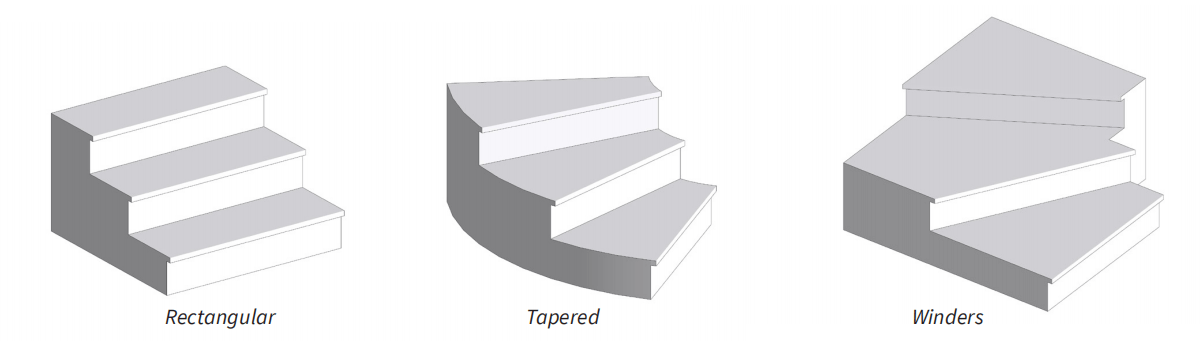
Definitions:
› Flight: a series of steps between landings.
› Run: the horizontal distance between two adjacent tread nosings on a stair.
› Tapered tread: a tread with non-parallel edges that increases or decreases its run uniformly over its width. The definition of tapered tread includes treads in curved stairs and treads in winder stairs. However, requirements for winders differ from those for other tapered treads. All tapered treads and winders within a curved flight must turn in the same direction.
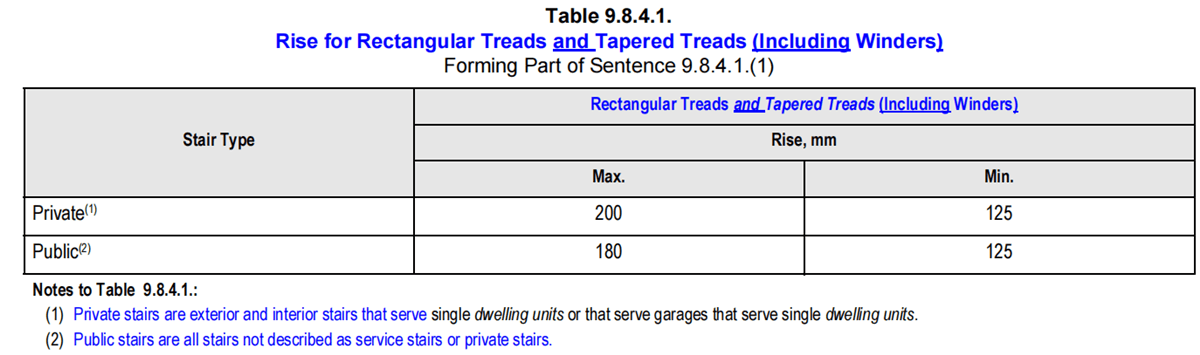
› Private Stairs: exterior or interior stairs that serve single dwelling units or that serve garages that serve single dwelling units.
› Public Stairs: all stairs not described as service stairs or private stairs.
9.8.3.1. Straight and Curved Runs in Stairs
(1) Except as provided in Sentence (2), stairs shall consist of,
(a) straight-runs, or
(b) curved-runs.
(2) Stairs within dwelling units shall consist of,
(a) straight-runs,
(b) curved-runs,
(c) straight-runs with winders, or
(d) straight-runs with curved-runs
9.8.3.2. Minimum Number of Risers
1) Except for stairs within a dwelling unit, at least 3 risers shall be provided in interior flights.
9.8.3.3. Maximum Height of Stairs
1) The vertical height of any flight of stairs shall not exceed 3.7 m
9.8.4. Step Dimensions
9.8.4.1. Dimensions for Risers
1) Except for stairs serving areas only used as service rooms or service spaces, the rise, which is measured as the
vertical nosing-to-nosing distance, shall comply with Table 9.8.4.1.
9.8.4.2. Dimensions for Rectangular Treads (Straight Flight)
The required rise and run dimensions have changed for stairs as listed in Table 9.8.4.2. and shown below. The dimensions
shown below also apply to some tapered treads. The changes of dimensions reflect current research on stair safety
9.8.4.3. Dimensions of Tapered Treads
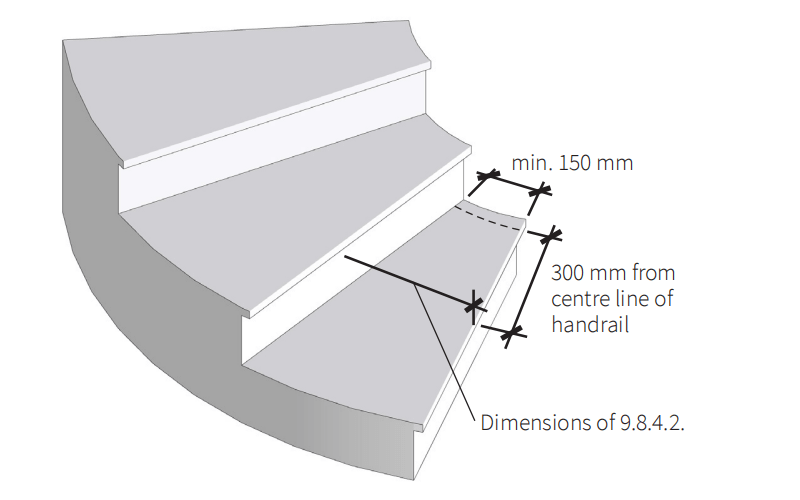
Tread dimensions for tapered treads are set to ensure minimum
and maximum run dimensions at the walking line. Tapered treads
must have a run that is not less than 150 mm at the narrow end of
the tread and comply with the dimensions stated in Table 9.8.4.2.
(see previous page) when measured at a point 300 mm from the
centre line of the handrail at the narrow end of the tread.
9.8.4.4. Uniformity and Tolerances for Risers and Treads
(1) Except as provided in Sentence (2), risers shall be of uniform height in any one flight with a maximum tolerance of,
(a) 5 mm between adjacent treads or landings, and
(b) 10 mm between the tallest and shortest risers in a flight.
(2) Except for required exit stairs, where the top or bottom riser in a stair adjoins a sloping finished walking surface such as a garage floor, driveway or sidewalk, the height of the riser across the stair shall vary by not more than 1 in 12.
(3) Treads shall have uniform run with a maximum tolerance of,
(a) 5 mm between adjacent treads, and
(b) 10 mm between the deepest and shallowest treads in a flight.
(4) Where angled treads or winders are incorporated into a stair, the treads in all sets of angled treads or winders within a flight shall turn in the same direction.
(5) The slope of treads shall not exceed 1 in 50.
9.8.4.5. Winders
(1) Stairs within dwelling units are permitted to contain winders that converge to a centre point provided,
(a) the winders turn through an angle of not more than 90°,
(b) individual treads turn through an angle of not less than 30° or not more than 45°, and
(c) adjacent winders turn through the same angle.
(2) Where more than one set of winders described in Sentence (1) is provided in a single stairway between adjacent floor levels, such winders shall be separated in plan by at least 1 200 mm.
9.8.4.6. Leading Edges of Treads
(1) Leading edges of treads that are bevelled or rounded shall,
(a) not reduce the required tread depth by more than 15 mm, and
(b) not, in any case, exceed 25 mm horizontally.
9.8.4.7. Interior Stairs Extending through the Roof
(1) Interior stairways extending through the roof of a building shall be protected from ice and snow.
9.8.4.8. Tread Nosings
(See Notes A-9.8.4.8. and A-9.8.4.)
1) Except as permitted by Sentence (2), the top of the nosings of stair treads shall have a rounded or beveled edge extending not less than 6 mm and not more than 14 mm measured horizontally from the front of the nosing.
2) If resilient material is used to cover the nosing of a stair tread, the minimum extension of the rounded or beveled edge required by Sentence (1) is permitted to be reduced to 3 mm.
Australia Stair Building Code
3.9.1.3 Stair Construction
Stairs must be constructed in accordance with the following:
(a) Each flight must have not more than 18 nor less than 2 risers.
(b) The nominal dimension of goings and risers of a stair must be constant throughout each stair flight except that
the going of winders in lieu of a quarter or half landing may vary from the going of the straight treads within the
same flight provided that the going of all such winders is constant.
(c) Treads must be of solid construction (not mesh or other perforated material) if the stairway is more than 10m
high or connects more than 3 storeys.
(d) A flight of stairs must not have more than 3 winders in lieu of each quarter landing or 6 winders in lieu of each
half landing.
(e) The riser opening must not allow a 125mm sphere to pass through between the treads.
(f) Treads must have a slip-resistant finish or a suitable non-skid strip near the edge of the nosings.
(g) Landings must-
(i) Be not less than 750mm long and where this involves a change in direction, the length is measured
500mm from the inside edge of the landing (see Figure 3.9.1.5, Diagram a); and
(ii) Have a gradient not steeper than 1:50; and
(iii) Be provided where the sill of a threshold of a doorway opens on to a stair that provides a change in floor
level or floor to ground level greater than 3 risers or 570mm (see Figure 3.9.1.5, Diagram b).
3.9.1.4 Riser and Going Dimensions
The riser and going dimensions for each flight, except for the going of winders in lieu of a quarter or half landing,
must comply with the following:
(a) The going (G), riser (R) and slope relationship quantity (2R+G) must be in accordance with Figure 3.9.1.2.
(b) The point for measurement of the going (G) in the slope relationship quantity as described in Figure 3.9.1.3
must be-
(i) For tapered treads (other than treads in a spiral stair)-
(A) Not more than 1m wide, the middle of the unobstructed width of the stair (see Figure 3.9.1.3,
Diagram b); and
(B) More than 1m in width, 400mm from the unobstructed width of each side of the stair (see Figure
3.9.1.3, Diagram c); and
(ii) For treads in spiral stairs, the point seven tenths of the unobstructed distance from the face of the centre
pole or support towards the handrail side (see Figure 3.9.1.4).
Measurement for openings in stairs
UK Stair Building Code
Private Staircase– for a domestic property.
Institutional & Assembly Stairs– are for serving a place where a substantial number of people will gather.(Public Staircase).
Other – are defined as offices, disabled, factories and common stairsserving morethan one dwelling. (Semi Public Staircase).
For the actual stair & staircase building regulation for this issue go to Point 1.2 (Page 6) atBuilding Regulations Part K.
The Rise And Going.
The most important regulation regarding domestic staircases is that:
1.Maximum rise of staircase 220mm.
2.Minimum going of staircase 220mm.
Private Staircase (Domestic) Max Rise = 220mm, min going 220mm.
Institutional & Assembly Max Rise = 180mm, min going 280mm.
Other (Semi Public) Max Rise =190mm, min going 250mm.
2. The maximum pitch of a domestic property is 42°
Private Staircase(Domestic) = 42° Maximum.
Institutional & Assembly Stairs (Public) = 33° Maximum.
Other (Semi Public) = 38° Maximum.
Please Note –that your stair tread cannot be too long or the riser too short because building regulation salsostate:
Twice the rise plus the going (2R+G) should be between 550mm and 700mm. For the actual stair & staircase building regulation regarding categoriesforsteepness of stairs go to 1.3; 1.4; 1.5; & 1.6 (Page 6) atBuilding Regulations Part K
Construction of Steps.
Building regulations stipulate that staircase steps should be level. Nosings should be at least 16mm.
For the actual stair & staircase building regulation regarding construction of steps go to point 1.8 (Page 6) atBuilding Regulations Part K.
Open Risers.
All stairs which have open risers should be constructed so that a 100mm sphere cannot pass through.
This regulation has been stipulated by the government in order that children’s heads cannot get stuck in any opening. For the actual stair & staircase building regulation regarding Open risers go to point 1.9 (Page 6) atBuilding Regulations Part K.
Head Room.
A headroom of 2m is required at all points on and off a staircase and as you pass down a staircase.
For the actual stair and staircase building regulation regarding Headroom go to point 1.10 (Page 7)Building Regulations Part K.
Headroom for Loft Conversions.
For loft conversions the headroom will pass the building regulations if the centre of the stair width is 1.9m reducing to 1.8m at the side of the stair.
Please Note – Where there are real difficulties in the height some building control officers will allow you to build a newel out from the wall to meet the regulations. This does make the staircase narrower but this may be the only option.
For the actual stair and staircase building regulation regarding Headroom go to point 1.10 (Page 7) at Building Regulations Part K.
MINIMUM WIDTH OF STAIRCASE.
There are no recommendations as to the width of a staircase – Yes Really!
There are rules for direct fire escapes and disabled access and you will have to consult Part M of the building regulations Building Regulations Part Mand talk to your building control officer who can interpret these rules differently.
However Pear Stairs recommend: To make a staircase visually pleasing and comfortable we would recommend that you don’t try to have a staircase narrower than 860mm overall string.
For the actual stair and staircase building regulation regarding minimum width of staircase go to point 1.11 (Page 7) at Building Regulations Part K.
MAXIMUM WIDTH OF STAIRCASE.
The maximum width of a public staircase is 1800mm. However this is easily overcome by putting an additional handrail, newel and spindles in the staircase.
US Spiral Stair Building Code
Building Code Requirement Highlights
- Minimum clear walking path of 26 inches. A 5-foot diameter or larger stair will provide this width
- Each tread will have a minimum of 7 1/2 inch tread depth at 12 inches from the narrow edge
- All treads will be identical
- The tread rise shall not be more than 9 1/2 inches high
- Minimum headroom of 6 foot 6 inches shall be provided, measuring plumb from the edge of the platform down to the tread below
- Landing width shall not be less than the required width of the stairway. Minimum spiral stair tread width is 26 inches – Salter’s code platforms start at 31 inches wide
- Stair balusters shall be spaced so a 4-inch object cannot pass between. The IRC Code permits a 4 3/8 inch space
- Balcony/Well Enclosure guardrail balusters shall be spaced so a 4-inch object cannot pass
- Balcony/Well Enclosure guardrail height shall not be less than 36 inches – If your state or municipality requires 42-inch tall guardrails, the sales order must reflect this detail
- The stairway shall be equipped with one handrail on the wide edge of the tread
- Handrail height, measured vertically from the tread nosing, shall be not less than 34 inches and not more than 38 inches
- Handrail grip size
- Type I-Handrails with a circular cross section shall have an outside diameter of at least 1 1/4 inches and not greater than 2 inches – Salter’s standard circular handrail is 1 1/2 inch diameter. This will address the UBC minimum cross section of 1 1/2 inch diameter. If the handrail is not circular, it shall have a perimeter dimension not greater than 6 1/4 inches
- Type II-Handrails, with a perimeter greater than 6 1/4 inches, shall provide a graspable finger recess area on both sides of the profile. For further information on our Type II options, please contact our sales department
- Verify what handrail size and shape your inspector will require. Handrail size and shape are a very controversial area within the building code. We recommend that you use our standard 1 1/2″ round handrails or our 1 3/4″ x 1 3/4″ solid wood handrail to comply with the proper circumference
- A 300 lb. concentrated load is required. On request, our sales department can provide structural calculations for your job specifications


